Risks and architectural constraints we addressed
Dataset isolation
From the outset, we separated the three knowledge domains:
- Tenant specific project data
- Internal product documentation
- General SEO knowledge
Retrieval is segmented at the infrastructure level. Customer data is always resolved through tenant aware queries with enforced row level security. Project context is injected before any retrieval occurs, ensuring data cannot cross organizational boundaries or leak into generalized answers.
Prompt discipline and response boundaries
Simply operates under strict system level instructions. The model is explicitly guided to:
- Use project data only when contextually relevant
- Separate observed metrics from general SEO best practice
- Frame interpretations as hypothesis driven where appropriate
- Decline questions outside authorized scope
This prevents the assistant from blending factual reporting with generic speculation and ensures analytical integrity.
Access control parity
The assistant inherits the exact same role based access model as the application itself. If a user does not have permission to view certain metrics in the interface, those fields are never made available in the retrieval step.
Permission validation happens before data is retrieved and before the model is invoked. This guarantees parity between UI visibility and conversational access.
Auditability and compliance
All interactions are logged with:
- User identity
- Active project context
- Retrieved dataset scope
- Generated response
Customer data is never used for model training. The assistant runs in inference mode with session bound context only, preserving data ownership and compliance boundaries.
Strategic positioning
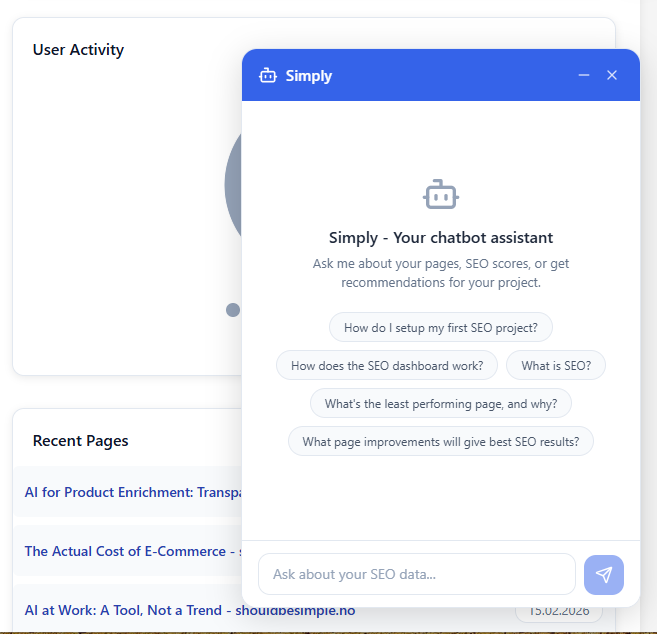
Simply is not a general purpose AI layer attached to an SEO tool. It is a controlled analytical interface built on top of:
- Structured project data
- Internal documentation
- Curated SEO domain knowledge
This architecture allows users to move seamlessly between operational questions, SEO theory, and real performance analysis without leaving the platform.
The result is a system that feels conversational on the surface but is tightly governed underneath. It delivers flexibility for the user while maintaining strict control over data boundaries, prompting logic, and access permissions.
Read more about the SEO report dashboard here.